
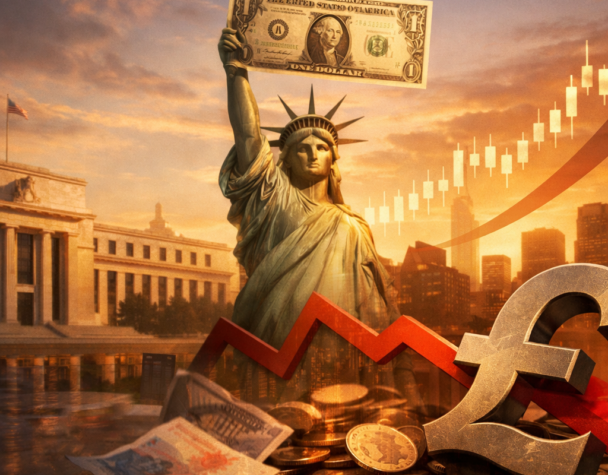
Hawkish Fed Spurs Dollar Rally; Pound Slides Today
Fri, June 19, 2026Introduction
Over the past 24 hours the U.S. Federal Reserve’s markedly firmer stance pushed the dollar sharply higher and nudged global yield curves upward. The Fed’s updated projections—showing a higher path for the federal funds rate—recalibrated investors’ expectations for policy duration and magnitude, triggering a broad-based USD rally. Concurrently, weaker UK inflation prints compounded pressure on sterling, leaving GBP/USD trading beneath key technical levels.
Major Move: Fed’s Hawkish Signal Drives Dollar Strength
The most significant development was the Fed’s hawkish pivot. Policymakers removed explicit easing guidance and signalled a higher terminal rate for 2026, lifting expectations that rates will remain elevated for longer. Market reaction was swift: the Dollar Index (DXY) rose from roughly 99.6 to above 100.5 and U.S. Treasury yields climbed as traders repriced the likelihood of additional tightening.
Why this matters for currencies
A stronger dollar and higher U.S. yields reshape global FX flows. Carry trades and risk-sensitive currencies typically sell off when U.S. real yields rise—investors prefer dollar-denominated assets offering higher returns. Emerging-market currencies and commodity-linked FX were particularly vulnerable to the repricing, while safe-haven demand for USD intensified. For FX traders, this means shorter-term momentum favors USD strength and places renewed emphasis on U.S. macro and Fed communication for rate expectations.
Immediate market impact
- Dollar Index (DXY): jumped to ~100.6 as positions adjusted to the new Fed dots.
- Treasury yields: moved higher across the curve, reinforcing the dollar’s appeal.
- G10 FX: most majors weakened versus the dollar, with heightened volatility in cross-currency pairs.
Minor but Notable: Sterling Slides on Soft UK CPI and USD Strength
On a currency-specific front, the British pound bore disproportionate downside pressure. Two factors combined: the broad dollar rally and softer-than-expected UK inflation readings that reduced the near-term case for aggressive Bank of England tightening. GBP/USD fell through the 1.34 region and traded around the mid-1.32 area during the immediate reaction.
Domestic and external pressures on GBP
Domestically, cooler CPI prints limit the Bank of England’s room to justify further hikes, or at least slow the pace of tightening. Externally, a resurgent dollar amplifies that weakness—when the funding currency strengthens, pairs like GBP/USD decline even if domestic fundamentals remain stable. Technically, breaching the 1.34 level—and testing the 200-day moving average—signals potential for continued near-term downside until fresh domestic data or BoE guidance shifts the narrative.
What traders should watch next
- U.S. Fed commentary and minute releases for any tweak to the hawkish tone.
- UK inflation and wage data for signs of re-acceleration or continued softness.
- Cross-asset flow: Treasury yield direction will remain a key driver for dollar moves.
Implications and Trading Takeaways
The Fed’s hawkish repricing is the primary influence across FX markets today, favoring dollar appreciation and pressuring high-beta and carry currencies. For risk managers and traders, the immediate priorities are monitoring central bank signals, macro prints that could alter rate paths, and technical levels where momentum may find support or resistance.
Practical considerations:
- Short-term USD strength suggests caution with long positions in risk-linked currencies unless hedged.
- For GBP, positioning should account for both domestic data risk and continued external USD pressure—staged entries or reduced exposure may be prudent.
- Keep an eye on U.S. real yields: a sustained rise will likely extend dollar gains across G10 and EM FX.
Conclusion
The Fed’s firmer posture has re-centered global FX focus on U.S. policy and yields, producing a clear dollar rally that reverberated through currencies worldwide. Sterling’s retreat after soft UK CPI illustrates how domestic softness can magnify losses when a major funding currency strengthens. Going forward, market participants will be closely parsing central bank language and incoming inflation data to gauge whether the dollar’s advance is sustained or ripe for a correction.