
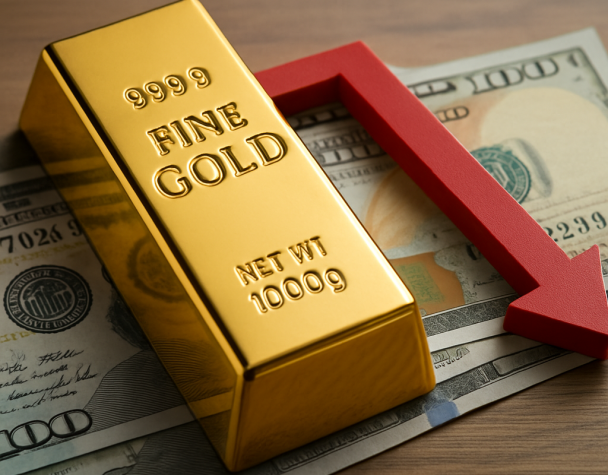
Gold Prices Decline Amid Rising U.S. Interest Rate Expectations
Tue, July 07, 2026Gold Prices Decline Amid Rising U.S. Interest Rate Expectations
As of July 1, 2026, the price of gold has fallen below $4,000 per ounce for the first time since November 2025, marking an 11.7% decline in June alone. This significant drop is primarily attributed to rising U.S. interest rate expectations amidst persistent inflation and robust economic indicators, such as resilient job growth.
Factors Contributing to the Decline
Gold, traditionally viewed as a safe-haven asset, has experienced a sell-off as investors seek liquidity and more attractive yield-generating assets like bonds, which become more appealing when interest rates rise. The appointment of hawkish Federal Reserve Chair Kevin Warsh has further reinforced expectations of higher rates in the near term, weakening gold’s short-term outlook.
Additionally, gold’s correlation with other market-sensitive assets, especially those affected by oil prices and inflation, has increased. Demand from central banks and exchange-traded funds (ETFs) has also slowed, contributing to the price drop. While gold’s defensive role during crises remains, its volatility and recent performance challenge its status as a reliable hedge.
Historical Context
Gold has experienced significant price fluctuations over the past century. In 1971, when President Nixon ended the dollar’s convertibility to gold, the price was fixed at $35 per ounce. By 1980, during a period of rampant inflation and geopolitical tensions, gold peaked at $850 per ounce. More recently, gold reached an all-time high of approximately $5,590 per ounce on January 28, 2026, driven by structural macroeconomic forces such as persistent inflation, record central bank accumulation, accelerating de-dollarization, and elevated geopolitical risk.
Investment Considerations
Despite the recent decline, many experts advocate maintaining a strategic allocation to gold due to its potential diversification benefits against inflation, geopolitical risks, and economic shocks. A suggested portfolio exposure of 5–10% is often recommended. Investors can gain exposure via ETFs, gold-mining stocks, funds, or physical gold.
Market Performance
As of July 7, 2026, the SPDR Gold Shares (GLD) is trading at $382.13, reflecting a slight increase of 0.01053% from the previous close. The VanEck Gold Miners ETF (GDX) is at $78.74, up 0.00408%. Among individual equities, Gold.com Inc. (GOLD) is trading at $44.05, up 0.00318%, and Newmont Corp (NEM) is at $98.20, up 0.01190%.
Conclusion
The recent decline in gold prices underscores the complex interplay between monetary policy, economic indicators, and investor sentiment. While the short-term outlook for gold may be challenged by rising interest rate expectations, its role as a hedge against inflation and economic uncertainty continues to make it a valuable component of a diversified investment portfolio.