
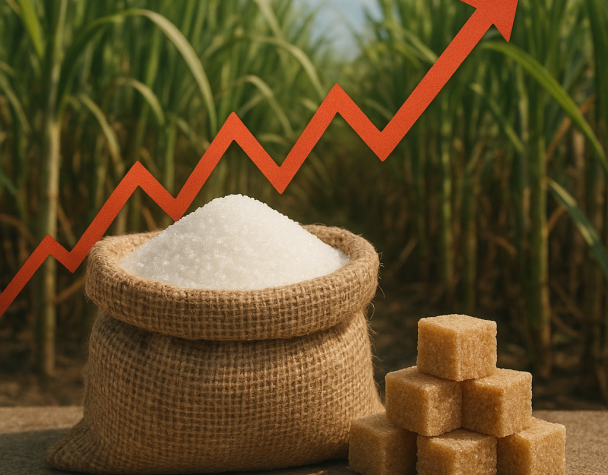
Global Sugar Supply Concerns Push Raw Sugar Futures to 16‑Month High
Sun, September 06, 2026Raw sugar futures on ICE surged to their highest level since April 2025, climbing to 18.77 cents per pound and settling at 18.70 cents on September 2, marking a 1.9% gain that followed a 3.1% rise the previous session.
Supply Worries Drive Market Rally
Market participants attributed the spike to growing concerns over constrained supply. In India, tight domestic supplies and firm local prices added upward pressure, while anticipated output drops in the European Union and Thailand further tightened global availability. Meanwhile, in Brazil, the world’s top sugar producer, forecasts point to significant rainfall—around 50 millimeters over the next 10 days—in key harvesting regions like Ribeirao Preto, potentially disrupting ongoing harvest operations.
Broader Market Balances Tighten
The International Sugar Organization’s quarterly outlook, released in August, highlights a marked tightening of global balances. The organization lowered its 2025/26 global sugar surplus estimate to 1.1 million tonnes, down from 2.2 million tonnes projected in May, signaling dwindling buffers. Looking ahead to 2026/27, ISO now projects a small global deficit of around 0.2 million tonnes, as consumption continues to edge higher while production outside of Brazil is expected to decrease. The imbalance may be softened by elevated stocks in regions such as the EU and Egypt.
Speculative Sentiment and Risk Factors
ISO cautioned that the recent price rally appears premature relative to fundamentals, though it noted that any deterioration in production—particularly amid mounting El Niño risks—could quickly turn the market more bullish. Speculative funds have notably increased their long positions, driven by heightened concern over El Niño and its potential to weigh on global output.
Implications for Investors and Market Watchers
For market actors and commodity investors, the recent raw sugar price jump underscores the growing sensitivity of sugar markets to weather and production risks in major producing regions. With Brazil’s harvest timeline threatened by rain, and key producers like India, the EU, and Thailand displaying signs of output weakness, volatility may persist.
Going forward, sustained monitoring of crop conditions in Brazil, updated production figures from India, and ISO’s subsequent balance sheets for 2026/27 will be essential to assess whether the current rally reflects short‑term disruption or the onset of a tightening structural cycle.