
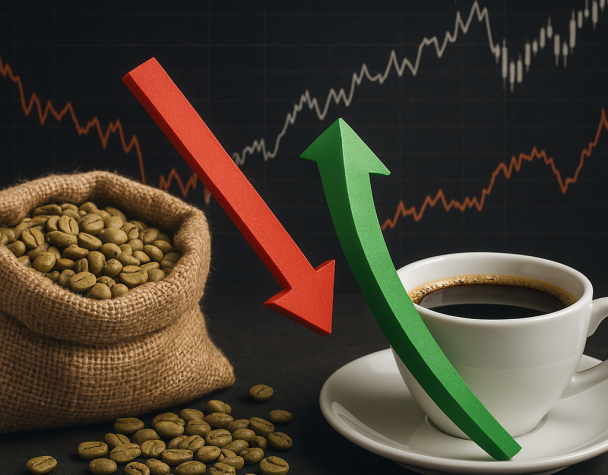
Coffee Market Faces Price Volatility Amid Supply Surplus and Retail Price Disconnect
Tue, July 07, 2026Introduction
The global coffee market is experiencing significant price volatility, influenced by a combination of supply surpluses and a notable disconnect between futures and retail prices. As of July 6, 2026, the price of Arabica coffee futures stands at $9.13 per pound, reflecting a 0.22% increase from the previous close.
Supply Surplus and Its Impact
One of the primary factors contributing to the current price fluctuations is a growing global supply surplus. Brazilian farmers, anticipating higher prices, have been withholding beans to push sales into 2026. This strategic withholding has led to an oversupply in the market, exerting downward pressure on futures prices. Additionally, market backwardation is driving speculators out, further intensifying the decline in futures prices. Coffee roasters are adopting a hand-to-mouth purchasing strategy to exploit falling prices, contributing to the overall market instability. Analysts expect further declines, with both Arabica and Robusta varieties remaining under pressure.
Retail Prices Remain Elevated
Despite the decline in futures prices, retail prices, particularly in the United States, remain at historic highs. According to data from the U.S. Commerce Department, the average retail price of ground coffee in the United States reached $9.72 per pound in April 2026, marking a new all-time high and extending a multi-month streak of record-setting prices. This represents a nearly 29% increase compared to April 2025, reflecting sustained inflation at the consumer level even as commodity prices soften. The disconnect underscores the lagged nature of price transmission across the supply chain and highlights the complex cost pressures still embedded in the market.
Historical Context and Inflation
Historically, coffee prices have been subject to significant fluctuations. According to the U.S. Bureau of Labor Statistics, prices for coffee are 1,015.44% higher in 2026 versus 1967, indicating substantial inflation over the decades. The current national average price is $2.83 for “Coffee, 100%, ground roast, 13.1-20 oz. can, per lb. (453.6 gm).” This data is collected by a national survey and can vary from region to region. Between 1967 and 2026, coffee experienced an average inflation rate of 4.17% per year, which is higher than the overall inflation rate of 3.96% during the same period.
Conclusion
The coffee market’s current state is a complex interplay of supply dynamics, market strategies, and consumer pricing. While futures prices are experiencing downward pressure due to supply surpluses and strategic market behaviors, retail prices remain elevated, reflecting the intricate and often delayed transmission of commodity price changes to consumers. Stakeholders across the supply chain must navigate these challenges carefully to maintain market stability and meet consumer demand.