
Brazil Record 2026 Coffee Crop Faces Heat Risk Now
Wed, March 25, 2026Brazil Record 2026 Coffee Crop Faces Heat Risk Now
Introduction
In the last week coffee headlines have been dominated by two opposing forces: forecasts pointing to a record Brazil crop for 2026 and field reports of heat and dryness that could blunt yields and quality. At the same time, benchmark price data and institutional supply forecasts are signaling a potential swing from tightness to surplus in 2026/27. For investors, roasters and origin stakeholders, this is a moment to reconcile satellite-driven optimism with farmer-level reality.
Brazil’s 2026 Crop: Record Outlook Meets Local Heat Stress
Record forecast versus field observations
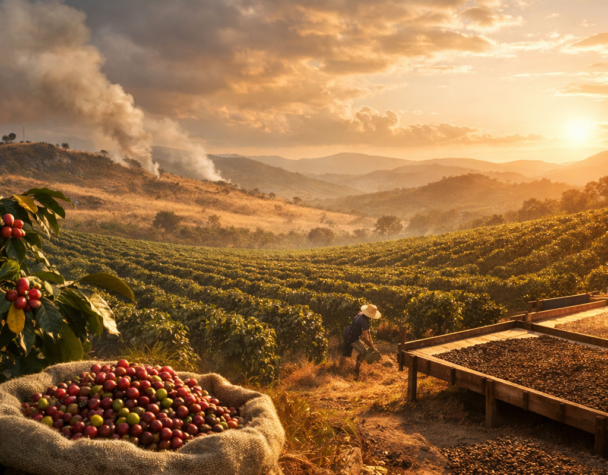
Forecasters have projected Brazil’s 2026 coffee output could reach roughly 66.2 million 60‑kg bags, a level that would relieve some of the tightness seen during 2024–25. However, growers in São Paulo and southern Minas Gerais have reported dry spells and extreme heat during key flowering and fruit setting windows in late 2025 and December heat events. These localized stresses can reduce bean development and degrade cup quality even when overall national production rises.
Why satellite and weather data matter
To bridge the gap between headline forecasts and farmer reports, analysts are increasingly relying on satellite vegetation indices, soil moisture models and rainfall anomaly maps. These tools offer a higher-resolution view of crop vigor than aggregate yield projections alone. Think of satellite monitoring as a health-check device: it won’t replace a farmer’s field report, but when combined with ground truth it improves yield accuracy and timing for price-sensitive decisions.
Price Signals and Supply Forecasts
ICO January data: a modest pullback
The International Coffee Organization’s Composite Indicator Price averaged 296.89 US cents per pound in January 2026, a 2.6% decline from December. Colombia’s Milds and Other Milds showed larger drops—about 2.8% and 4.5%, respectively—after rainfall eased localized supply worries in Minas Gerais. These moves indicate that short-term weather improvements can quickly translate into price relief.
Institutional outlook: Rabobank’s surplus projection
Rabobank’s early‑year outlook suggests the coffee complex could shift into a material surplus of roughly 7–10 million bags in 2026/27, with projected price settlement in the range of $2.50–$3.50 per pound by year‑end 2026. If realized, that surplus would exert downward pressure on prices, particularly for bulk Arabica grades that are most sensitive to supply changes.
Climate Trends and Quality Concerns
Rising heat exposure 2021–2025
Analyses from climate research groups show increased heat exposure across key coffee regions from 2021 through 2025. Heat stress affects flowering synchrony, fruit set and the biochemical pathways that determine cup quality. Even in years of high berry counts, hotter seasons can increase defect rates and reduce the proportion of specialty‑grade beans—creating a widening gulf between volume and quality.
Quality premiums may diverge from bulk prices
As volume normalizes, expect greater price dispersion: bulk Arabica prices could soften under surplus pressure, while premiums for specialty and high‑altitude origin lots may firm if heat reduces the supply of top‑grade beans. Roasters seeking consistent cup profiles may pay more for traceable lots even as indices decline.
Implications for Traders, Roasters and Producers
Practical risk-management strategies
Given the mix of upside supply forecasts and climate uncertainty, a blended approach to risk is warranted. Traders might use calendar spreads to capture narrowing between nearby and deferred contracts during a surplus transition, while options can provide asymmetric protection against weather-driven shortfalls. Roasters should consider staggered forward purchases and origin contracts that specify quality parameters to protect cup profiles.
Operational moves for origin stakeholders
Producers and cooperatives can leverage satellite data to make targeted agronomic interventions—such as shade management and irrigation prioritization—where heat stress is concentrated. Investments in post‑harvest sorting and dry‑mill quality control will help preserve value when overall yields grow but quality is uneven.
Conclusion
The latest week’s developments present a dual reality: headline forecasts for a record Brazil crop suggest softer prices ahead, yet localized heat and moisture stress threaten yields and, critically, quality. Benchmark price data and Rabobank’s surplus projection point to downward pressure on bulk Arabica, but climate trends imply persistent upside risk for premiums on specialty lots. For investors and origin participants the priority is timely, data‑driven monitoring—combining satellite indicators, regional weather models and ground reports—and a layered hedging or purchasing approach that preserves optionality as the season unfolds.
Data referenced: ICO Composite Indicator Price (Jan 2026 avg 296.89 US cents/lb, -2.6% m/m); Rabobank surplus estimate 7–10 million bags for 2026/27; Brazil 2026 forecast ~66.2 million bags; regional heat and dryness reports from São Paulo and southern Minas Gerais (Dec 2025).