
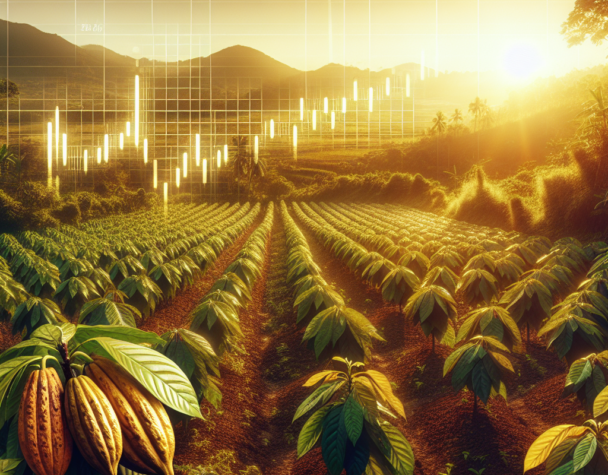
West African Cocoa Tightness Lifts Prices 25% YTD!
Wed, December 31, 2025Introduction
Cocoa futures have seen renewed strength this week as fresh supply revisions and a high-profile index inclusion converged to tighten near-term fundamentals. Official agency and bank updates trimmed surplus and production estimates, while the planned addition of NY cocoa to the Bloomberg Commodity Index (BCOM) is set to inject meaningful passive flows. This article summarizes the concrete developments that moved prices and explains practical implications for producers, processors and investors.
What changed: supply revisions and index flows
ICCO and analysts cut surpluses, lowering production estimates
The International Cocoa Organization (ICCO) reduced its 2024/25 surplus estimate sharply, and trimmed global production forecasts for the season. Concurrently, commercial forecasters such as Rabobank lowered surplus projections for 2025/26. Those downward adjustments reflect a tighter-than-expected physical balance and helped push futures to the recent highs.
BCOM inclusion adds predictable bid
Beginning in January, NY cocoa futures will be included in the Bloomberg Commodity Index. Market estimates put passive inflows at roughly US$1.5–2.0 billion phased over about 80 trading days as index funds rebalance. That mechanical demand provides a notable short-term support under futures prices, effectively creating a financial floor while the physical market digests the reduced supply outlook.
Drivers behind the supply squeeze in West Africa
Aging trees, weather and disease
Ivory Coast and Ghana—which together supply the majority of the world’s cocoa—continue to show signs of structural stress. Aging tree stock, periodic droughts and unseasonal rains, and outbreaks of cocoa-specific diseases are all contributing to lower yields per hectare. Analysts have trimmed output expectations accordingly: recent figures point to Ivory Coast output near 1.6 million tonnes and Ghana slipping below 600,000 tonnes in the coming season.
Local disruptions and underinvestment
Non-agricultural pressures have amplified the problem. Illicit mining, labor constraints, and limited fertilizer and infrastructure investment reduce effective harvested area and raise production costs. Those factors are slower to fix than weather-related hits, meaning supply risk remains elevated through at least the next one to two seasons unless targeted interventions accelerate.
Demand dynamics: grindings and ‘demand destruction’
Industrial consumption has weakened
Higher cocoa prices are translating into lower industrial use. Recent grindings data show marked declines across key regions: Europe’s grindings fell in the mid-single digits to double digits year‑on‑year in recent quarters, Asia recorded steeper drops, and North American activity showed mixed results. This pattern is consistent with what analysts call “demand destruction,” where elevated raw-material pricing forces processors to reduce intake or substitute ingredients where possible.
Why demand weakness tempers the rally
Even with supply tightening, persistent reductions in industrial demand cap the upside. The index-driven inflows provide a temporary price floor, but sustained price increases require physical restocking or a rebound in grindings. If demand remains subdued, financial support can unwind once index flows complete or if macro conditions shift.
Practical implications and tactical takeaways
For producers and origin buyers
Producers in West Africa can expect firmer local prices as exporters and intermediaries pass through global tightening. Origin buyers should prioritize forward coverage and quality-focused procurement to lock volumes at known prices while monitoring crop and weather reports closely.
For traders and investors
Index inclusion creates a defined window of technical support—consider strategies that reflect this finite timeline. Long exposures can be attractive if financed out to periods where supply risk remains credible (e.g., next two harvest cycles), but hedging is advisable given fragile demand indicators. Structured positions or collars can capture upside from supply surprises while protecting against downside from prolonged demand weakness.
Conclusion
This week’s cocoa price action reflects a tangible tightening in fundamentals. Official revisions to surplus and production estimates, combined with mechanical support from BCOM inclusion, have underpinned futures. However, the rally is balanced by real demand erosion in grindings. Market participants should base decisions on objective, short‑term flow drivers (index rebalancing) and medium‑term physical signals (West African crop reports, weather and disease surveillance), using layered hedges to manage asymmetric risk.
Relevant metrics to watch next: ICCO monthly balances, official crop updates from Côte d’Ivoire and Ghana, regional weather outlooks, and the pace of BCOM-related ETF and index fund flows over the initial 80‑day window.