
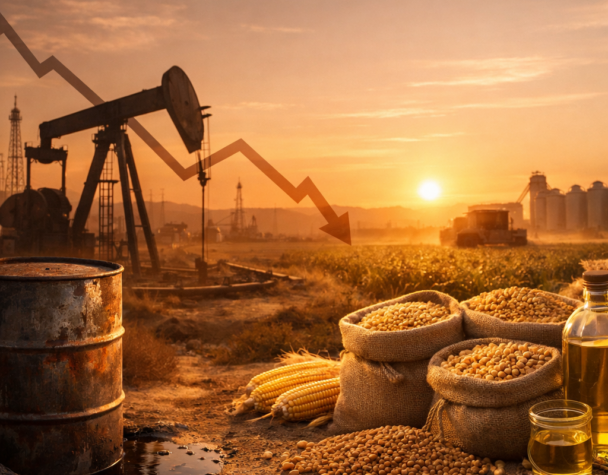
World Bank Sees Commodity Prices Slide to 2026 Low
Mon, April 06, 2026World Bank Sees Commodity Prices Slide to 2026 Low
Recent official reporting points to a turning point across raw-material markets. The World Bank’s latest outlook projects commodity prices falling to their lowest level in six years by 2026, driven primarily by a persistent oil surplus and cooling industrial demand. At the same time, short-term divergence is evident within the commodity complex: agriculture — especially grains and oilseeds — posted monthly gains in March, according to StoneX, while many industrial metals softened.
What the World Bank Forecast Means
Primary drivers: oil surplus and weak industrial demand
The World Bank identifies a structural oil glut and subdued manufacturing activity in key economies as the core forces pushing prices lower. An oil surplus acts like a floodgate: abundant crude increases downstream inventories and keeps energy costs depressed, which then ripples into lower quoted prices for many commodities that are priced in oil-linked terms.
Sawtooth volatility: intermittent rallies amid a downward trend
The report highlights a ‘‘sawtooth’’ pattern — intermittent rallies driven by geopolitical events or supply scares, followed by deeper corrections as oversupply and demand weakness reassert themselves. Think of it as ocean waves: sudden surges crest briefly, but the tide still moves steadily toward the shore.
Sector Spotlight: Agriculture Gains, Metals Weaken
Grains and oilseeds: March strength and drivers
StoneX’s April report shows grains and oilseeds rising 3.9% month-on-month in March, following a 7.0% jump in February. Soybean oil emerged as a standout as higher crude prices bolstered expectations for biofuel demand, while rising freight, fuel, and fertilizer costs also tightened farmer margins and supported prices. In short, energy-driven cost pressures and biofuel linkages are propping up specific agricultural contracts even as broader commodity indices trend lower.
Natural gas and industrial metals: mixed signals
Natural gas recovered modestly in March (around +2.6% MoM) after sharp declines earlier, reflecting milder supply concerns and improved storage expectations in major consuming regions. By contrast, most industrial metals weakened — a symptom of softer manufacturing demand and higher input costs that diminish immediate consumption prospects for base metals.
Practical Implications
For exporters and producers
Countries and companies reliant on commodity exports face extended pricing pressure. Producers with high fixed costs or elevated break-even prices may need to manage cash flow conservatively, prioritize hedging strategies, and consider cost-cutting or production discipline to protect margins.
For policymakers and inflation outlooks
Sustained lower commodity prices would ease input-cost inflationary pressures globally, giving central banks more room to focus on domestic labor and services inflation. However, temporary energy shocks tied to geopolitics can still cause short-lived price spikes, complicating near-term policy windows.
For traders and investors
Volatility will remain a hallmark of the months ahead. Traders should expect news-driven rallies but plan for mean reversion as oversupply fundamentals reassert themselves. In agriculture, watch the biofuel linkage — crude moves can lift soybean oil — while metal bulls will need clearer signs of manufacturing recovery to justify sustained upside.
Conclusion
The World Bank’s forecast signals a quieter long-term price environment for commodities headed into 2026, largely driven by an oil surplus and tepid industrial demand. Yet the commodity complex is not monolithic: agriculture, especially biofuel-linked oils, can outperform on cost and demand dynamics even while broad indices decline. The near-term picture will be defined by a mix of structural oversupply and episodic shocks, requiring different tactical responses across sectors.
Policymakers, producers, and investors should prepare for a lower-price baseline but remain alert to intermittent supply or geopolitical events that can produce sharp, temporary reversals.